Both books are on many productivity lists. You don’t want to read the same thing twice. Atomic habits vs deep work: which do you need?
You get the difference, which book comes first and how the two fit together. Then you see why one focused block is the habit to build. Last, you see where the four laws of Atomic Habits show up in it.
What is the difference between Deep Work and Atomic Habits?
Deep Work is about a kind of work. Atomic Habits is about how any behavior becomes a habit.
Cal Newport describes deep work as professional activities done in distraction-free concentration that push your mental abilities to their limit. Read more about what deep work is.
James Clear’s book is about habits: tiny changes, remarkable results. The table sums up both in my words.
| Deep Work | Atomic Habits | |
|---|---|---|
| What it’s about | A kind of work: demanding, without distractions | Habits: tiny changes with remarkable results |
| Its question (my reading) | Which work deserves your full attention? | How does a behavior become a habit? |
| Scope | One kind of work | Any behavior |
In my view, the books aren’t rivals. One shows which work to protect. The other shows how to repeat a behavior.
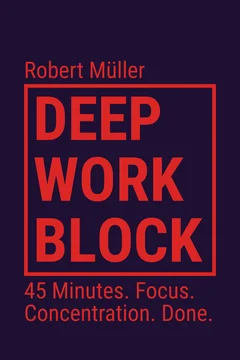
My book has you repeat one unit: the block. A block is one stretch of concentrated work, 15 to 90 minutes, depending on how you feel today. See how long a deep work session should be.
Deep Work or Atomic Habits: which should you read first?
Since the two books answer different questions, start with the one that fits your problem. Is it your focus while you work, or is it starting and keeping going? This is my own simple rule, not a tested order.
- Your focus breaks while you work: start with Deep Work. It argues for focus without distractions on demanding work.
- You struggle to start or to keep going: start with Atomic Habits. It is about turning a behavior into a habit through small changes.
- Both sound like you: pick the problem that costs you more right now, and read the other book later.
Whichever you pick, take one idea into your next block instead of waiting until you finish the book.
You don’t have to put everything into practice at once. Take what works for you. If you’re comparing more books, see how Deep Work compares with Slow Productivity.
How do Deep Work and Atomic Habits fit together?
In my view, the two books fit together, whichever you read first. Deep Work names the work worth protecting. Atomic Habits is about coming back to a behavior day after day.
Coming back gets easy when the next step is on paper. Here is how that looks when a block ends.
That’s a small habit. It happens at the same moment every time: when a block ends. If starting is hard for you, read about when deep work feels impossible to start.
Goals, systems and a single block
Notes and timers like these form a system, and Clear says your systems matter more than your goals. A block has both: a written goal for direction and a small system around it. Here is how he puts it in Atomic Habits:
“You do not rise to the level of your goals. You fall to the level of your systems.”
James Clear, Atomic Habits
A goal in your head is vague, but on paper it’s binding. Without one, you work with no aim. With one, you work toward something.
So each block gets a block goal: the result you want from it. It goes on your protocol sheet, a sheet for your goal and work steps.
The block timer tells your brain that the work has an end. It gives your work structure and saves willpower.
A block doesn’t make you choose between goal and system. The goal sets the direction. Timer and sheet keep you at the task.
Why one block is the habit worth building
Goal and system both sit inside a single block. My book starts there and builds the day from blocks you repeat. Repeating is what multiplies what you get done.
Setting up a block looks like a lot of work at first, but it goes fast. After a few rounds, it takes only a few minutes. That’s because you know what to do and it runs on autopilot.
You don’t need every step every time. By the second block of the day, your space is already set up. Read more about building a deep work routine.
It didn’t take long for my blocks to become a habit. I don’t remember exactly how long, because I’ve used my system for a long time.
Clear’s four laws and one block
Three of Clear’s four laws have a match in the steps around that one block. For the fourth, my book has no step.
Clear calls his four rules the Four Laws of Behavior Change. The table shows my view of where each law fits in my book’s steps. It does not show what Clear himself prescribes.
| Clear’s law | Around one Deep Work Block |
|---|---|
| Make it obvious | Tomorrow’s first task, noted the evening before |
| Make it attractive | No step of its own in my book |
| Make it easy | A clean desk and a shorter block if you’re unsure |
| Make it satisfying | Review what you got done, then celebrate it |
I don’t try to make the block itself pleasant. Music makes work more pleasant, and that’s what we wrongly think of as productive. Silence is uncomfortable, and that’s why it works.
The feeling of satisfaction at the end of the day is the fuel that makes you start again tomorrow. Read more on how to build a deep work habit.
Atomic Habits can help you come back every day. The question is what you come back to. Make it one block of 15 to 90 minutes that ends with something done. See how it works →
FAQ
Is Atomic Habits also about breaking bad habits?
Yes. One edition of Clear’s Atomic Habits has the subtitle “An Easy & Proven Way to Build Good Habits & Break Bad Ones.”
The way I see it, the book works in both directions. It helps you add a behavior and drop one.
Did Cal Newport and James Clear ever talk about their books?
They did. In 2019, Cal Newport recorded a podcast conversation with James Clear for the first anniversary of Atomic Habits. In a blog post about it, Newport called Clear’s habit-building framework quite useful for readers who want better deep work.
Is Deep Work Block a book about habits?
No. Deep Work Block is my short, practical guide to a single block of concentrated work. Habits come up only where they matter for the block. That topic would be a book of its own.