You’ve met the term, and you know the days it describes: full of activity, with little that is actually finished. Before you build your days around deep work, you want to know whether it’s worth the effort.
Here you get the plain reason why deep work matters and what it gives you on a normal working day. You’ll also see which big claims about it hold up. And you’ll see whether it still matters when your job is full of interruptions.
What deep work is, and what it isn’t
Deep work is focused work on something demanding. A busy day full of small things is not, however full it feels. Cal Newport’s definition is short:
“the act of focusing without distraction on a cognitively demanding task”
Cal Newport, page for his book Deep Work on his website, 2015
The opposite of deep work is activity that never finishes anything. You scroll, you rearrange things, you check emails. At the end of the day you were busy, but you didn’t actually get anything done.
Busy is not done. That’s why I don’t measure deep work by the day.
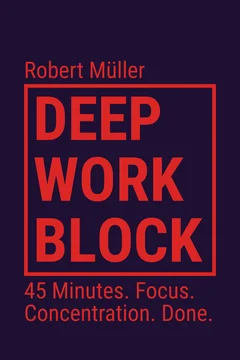
I measure it by a smaller unit, a single Deep Work Block. That is one stretch of concentrated work with a goal and an end.
I judge deep work by what one such block produces, not by how long you sat at your desk. That unit became important to me for a practical reason.
Why deep work is important to me
For me deep work was never a theory. Without it, my projects don’t get finished. That is the plainest reason why deep work is important that I know.
I read everything: books about focus, concentration, deep work. They explain the science behind it and why focus matters.
What none of them told me was how to actually sit down and work with concentration for 45 minutes. How to prepare, how to start, what to do when my focus breaks. So I judge deep work by what a single block gives me on a normal day.
What is the value of deep work?
The value of deep work shows at the end of the day, in what your blocks produce.
Each block starts with a written goal. Without a goal you work somehow; with a goal you work toward something. Over a day, that adds up to three things:
- A result, not just activity: goal by goal, your sheet turns into a complete list of everything you got done.
- Satisfaction: looking at that list feels good, and that feeling is what makes you start again tomorrow.
- A real evening off: recovery in the evening is as much a part of your productivity as the work itself.
I sum up that value in one rule, written for a normal working day, not a perfect one:
That rule is a judgment from daily practice, not a measured result. You can check it yourself in a single block with a written goal and an honest look at the result. How to run that check follows two sections down.
What fragmented work really costs
Work in fragments can feel fast, but it costs you the unbroken time that hard results need, and your calm. It is the other side of the three-blocks rule. Novelist Neal Stephenson makes this point in his essay “Why I Am a Bad Correspondent”.
He says that writing novels is hard and needs vast, unbroken stretches of time. Two two-hour slabs may total four hours, he wrote, but are far less productive than an unbroken four. That’s one writer’s testimony, not a study.
One lab study found something more specific. Gloria Mark, Daniela Gudith and Ulrich Klocke (CHI conference paper, 2008) had people answer emails with interruptions every two minutes. The interrupted tasks were done in less time, with no difference in quality.
But after about 20 minutes, people reported more stress, frustration, time pressure and effort. So the cost was the state they worked in, and the task was email, not demanding deep work. Demanding work has a further cost: flow is fragile, and once you’re out, it takes minutes to get back in.
Is deep work really rare and valuable, or just Newport’s opinion?
The cost of fragments showed up in a lab. But the “rare and valuable” claim is Cal Newport’s opinion, his Deep Work Hypothesis.
It is not a measured fact. It says deep work becomes more valuable as it becomes rarer, so people who cultivate it thrive. You’ll meet it next to other popular claims, and they all deserve the same check:
| Claim | What the evidence shows | Holds up? |
|---|---|---|
| Deep work is rare and increasingly valuable | Newport’s hypothesis, not a measured result | Unproven thesis |
| Task switching eats up to 40% of your time | Traced to a blog; a 2001 lab study’s abstract reports no percentage | Not as stated |
| Deep work rewires your brain, builds myelin | One study: 17 adults, motor-skill training, not deep work | Not shown |
| Gates, Rowling, Darwin prove it | Anecdotes without data; Darwin claim sourced to a personal blog | No proof |
One lab study on task switching is Rubinstein, Meyer and Evans (2001). Its abstract reports switching-time costs in lab tasks, not a share of productive time. The myelin study is Lakhani et al. (2016), with 17 healthy young adults training a visuomotor skill.
I haven’t run a study and I don’t hold a chair. I had a problem and solved it, in the daily work of a sole proprietor.
So my test for whether deep work works is practical, and you can run it yourself. I don’t count blocks, I look at results. Do one block with a written goal, then look at what it produced.
Does deep work matter if your job doesn’t allow it?
Yes. The test above works there too, because a smaller unit is enough: one protected block, even a short one.
Maybe you work in an open office with a chat tool that never goes quiet. Or you work in support, with requests coming in all day. And if you’re the team’s expert, being unreachable has a cost for the others.
That’s why I start small. To learn focused work, you begin with the smallest unit, a single block of concentrated work. Three steps show how to do deep work in that unit:
- Tell the people who contact you regularly that you’re unreachable at certain times.
- Set the timer, even if it’s only for 15 minutes. That’s better than nothing.
- Write the block goal as a finished state, not as an activity.
None of this needs a private office or a quiet team. Open offices, full-time jobs and teams each deserve their own article, so here only the principle counts. If one short, protected block fits into your week, deep work matters there too.
So start with that one short block. What you do before the timer starts decides whether the block ends with a result or just activity. See how it works →
FAQ
How many hours of deep work a day do you need?
Deep work has a realistic upper limit of four to six highly concentrated hours per day. Some people manage less, some more.
Eight hours of full concentration is unrealistic. Better one block too few than one too many.
Is deep work the same as flow?
No. Deep work and flow differ.
Flow is the state where you’re most productive, and deep work is the work that gets you there. Every step of a Deep Work Block, from the preparation to the breaks, exists to get you into it.
Why is deep work so hard if it’s so important?
Deep work is hard because your environment works against it: your smartphone is built to capture your attention. When you still can’t focus, the cause is more likely a missing process than missing discipline.