You’ve seen “deep work” in a book, a podcast, a calendar tool or a colleague’s status message. Maybe it’s just a new word for working hard. And does your own work even count?
Here you get the meaning of deep work in plain words and a quick check for any task. Then you see what deep work is not. You’ll also see how long a block can run, with a look at my own working day.
What does deep work mean?
Deep work means two things at once: a task that demands your full thinking, and working on it without distraction.
Full thinking means the task stretches what you can do. You can’t do it on autopilot. Here is Cal Newport’s definition of deep work, in the words of his book:
“Professional activities performed in a state of distraction-free concentration that push your cognitive capabilities to their limit. These efforts create new value, improve your skill, and are hard to replicate.”
Cal Newport, Deep Work (2016)
In plain English: such work takes you to the edge of what you can do. Newport names three results.
It creates something new, it makes you better at what you do, and others can’t easily copy it. Those three results are also why deep work is important.
The term is older than the book. Where the term deep work comes from is a blog post from 2012. There, Newport used the term for demanding work that uses your training to produce rare and valuable results.
The book’s definition adds distraction-free concentration.
What counts as deep work?
Since the definition has two parts, a task counts as deep work only when both are true. If one is missing, it isn’t deep work, however busy it feels. Here’s a quick check built from the two parts of the definition:
- Thinking: Does this task need my full thinking?
- No distraction: Am I doing it without switching to email, phone or chat?
- Both: Two yeses mean deep work; one no means it isn’t.
The opposite is shallow work. That’s Newport’s name for logistical tasks that don’t demand much thinking and are often done while distracted. The full contrast is in deep work vs shallow work.
Which tasks typically pass the check, field by field, you’ll see in these examples of deep work.
The two questions don’t ask about the clock. Nothing in them says how long a task must run to count.
What counts as deep work time?
The check has no clock because no fixed number of minutes makes work deep. A block is a fixed stretch of focused work on one task.
It lasts as long as your state allows, and the result is the measure. Here’s my own day:
The length of a block follows your current state. That means 90 minutes at maximum fitness and motivation and 45 when you’re fit, focused and motivated. It goes down to 15 when you’re strongly unmotivated.
If you’re in flow, fully absorbed in the task, keep working past the timer. The point is to get something done.
So don’t count blocks, look at results. Two blocks with good results beat five you dragged yourself through. Whether there is such a thing as the minimum time for deep work is a question of its own.
Knowing what counts also means knowing what only looks like deep work.
What deep work is not
Some work only looks like deep work because it misses one of the two parts. And deep work is not the same as flow. Here are three things that look like deep work at first glance, and the part each one misses:
| Looks like deep work | What’s missing |
|---|---|
| Eight hours at your desk, half concentrated | Full focus: half attention over long hours |
| Routine tasks with your phone off | A demanding task: no distraction, but little thinking |
| An interesting tangent in the middle of a block | No distraction: it feels like work but drifts from the task |
The tangent is easy to miss, because it feels like work. Put it on the thought sheet, a second sheet of paper for stray thoughts, and return to the task.
The definition speaks of activities, so deep work is something you do, not a mood you wait for.
Deep work is also not the same as flow. Flow is the state in which you’re most productive. The preparation, the start and the goal of a block exist to get you there.
Deep work is the work; flow is a state it can lead to. More on that in deep work vs flow.
Is deep work just a buzzword?
Now that you know what only looks like deep work, the doubt from the start remains. Is deep work just a new word for working hard? No.
A hard-working day can miss both parts. Working all day while switching between tasks misses the second part, and quiet routine work misses the first. Because the term names two parts you can check, it’s more than a label.
I read the books on focus, concentration and deep work. They explain why focus matters. None of them showed me how to actually sit down and work with concentration for 45 minutes.
So I started with the smallest unit: a single block of concentrated work. Over the years I tested each step, discarded and refined it. Not out of academic interest, but out of necessity.
A block gives you the conditions for both parts: one task, one written goal, nothing else open on your screen. Whether the task is demanding depends on the task itself. Where to begin is covered in how to do deep work.
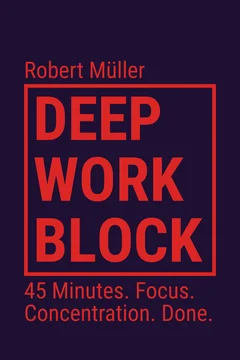
That frame comes from a few steps before, during and after the block. Half an hour of reading, and your next task can get 45 focused minutes, from preparation to a clean stop. See how it works →
FAQ
Is deep work a method or a technique?
Deep work names a kind of work, not one fixed method. Methods are ways to make room for deep work. One such method works in single blocks: prepare, start, work, stop, take a break, repeat, and close out the day.
What is deep work in business?
In business, deep work is the demanding work that moves projects forward, done without switching to email or chat. I’m self-employed: if I don’t work with focus, my projects don’t get finished and I don’t make money.
What is deep work in time management?
In time management, deep work is time you reserve for one demanding task and protect from interruptions. Put demanding tasks where your energy is high and easier ones where it fades. And tell the people who contact you regularly when you’re unreachable.