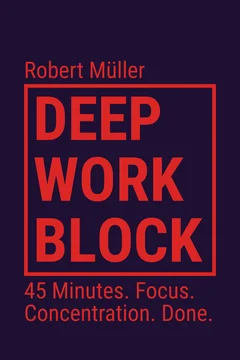
You have a free block tomorrow morning and a to-do list in front of you. A report, a full inbox, a code review, a meeting to prepare, a chapter you keep avoiding. Which of these is deep work, and which one deserves the block?
Here you get deep work examples sorted by what they produce. You also get a two-question test for your tasks and clear answers for borderline cases. At the end you’ll know what to put into your next block.
What is considered deep work?
Deep work is work that needs your full concentration and your trained skill and ends in something new. Cal Newport gave an early definition of deep work in a 2012 blog post:
“Cognitively demanding activities that leverage our training to generate rare and valuable results.”
Cal Newport, “Knowledge Workers are Bad at Working (and Here’s What to Do About It…)”, 2012
In the same post he describes the opposite, shallow work. He calls it “tasks that almost anyone, with a minimum of training, could accomplish.” His examples are replying to e-mail, logistical planning and tinkering with social media.
So two things have to come together. The task has to be demanding and produce a new result, and you have to work on it without interruption. Flow is fragile: once you’re out, it costs you minutes to get back into deep work.
Hard or long isn’t enough. Tedious work that needs no thinking stays shallow, however many hours it eats.
What are examples of deep work?
Deep work examples fall into a few families of tasks. Each one ends in a new result you can name before you start. So sort by what the task produces, not by your job title.
| Task family | Example | Block goal (written as a result) |
|---|---|---|
| Writing | Drafting an article, report or chapter | ”First draft of the outline is done” |
| Code | Debugging a hard bug, designing an architecture | e.g. “Cause of the bug is found” |
| Analysis | Turning data into a conclusion | e.g. “Three findings are written down” |
| Strategy | Planning a launch or a project | e.g. “Plan for the launch is drafted” |
| Design | Developing a concept or layout | e.g. “Two layout options are sketched” |
| Learning | Working through a hard chapter or problem set | e.g. “Problem set 4 is solved” |
The same families show up in every knowledge job, whether you’re employed, freelance or studying (see deep work for students). Examples for specific roles get their own articles.
The last column follows one rule. Write the block goal as a completed state, never as an activity: “is done,” not “do.” The writing goal is my example from Deep Work Block; the others follow the same rule.
How can you tell if a task is deep work?
You can tell with two questions about the task and one condition about how you work on it.
- Training: Does it need skill most people don’t have?
- Result: Does the block end in something new, something that didn’t exist before, not just a cleared pile?
- Condition: Two yeses make a deep task. It only becomes deep work if you give it a block without interruption.
If your answer to the result question is vague, the task isn’t ready yet. Write the block goal first.
Both yes? Then it gets your best energy, and easier tasks wait for when your energy fades.
A no doesn’t make a task useless.
Is email, a meeting or reading deep work?
Usually not. A block for your inbox doesn’t turn email into deep work. The name of the task doesn’t decide either; the two questions do.
Sometimes a task you filed as shallow turns out not to be.
| Task | Usually | Deep when … |
|---|---|---|
| Shallow: replying, sorting, forwarding | You write a proposal that needs your full expertise | |
| Meeting | Shallow: status, coordination | Rarely; the preparation before it can be a deep block |
| Code review | Shallow for small changes | You review a design that needs your full expertise |
| Reading | Shallow when skimming or browsing | You work through a hard text and write down conclusions |
| Planning | Shallow: logistics, scheduling | You plan a strategy or a project from scratch |
Most of the “usually” column fails the result question: you clear a pile, you don’t make something new. Those tasks still have to be done, just not in your best hours.
Once you’ve found your deep task, the next question is what working on it looks like.
What does deep work look like in practice?
In practice, deep work is rarely a week in a cabin. It’s one block at your desk with a goal on paper, even if the famous examples suggest otherwise.
The Seattle Times described Bill Gates’s “think week” in 2005. It was a twice-yearly, seven-day stretch of seclusion in a waterfront cottage. He spent it reading hundreds of papers from Microsoft staff.
J.K. Rowling finished Harry Potter and the Deathly Hallows in Edinburgh, at the Balmoral Hotel. That was on 11 January 2007 (The Scotsman, 2007).
Good stories, but you can’t copy either of them on a normal Tuesday. What you can copy is a single block: make the music decision, set the timer, write down the goal. The goal takes up to five steps:
- Write down the end goal, as a state already reached: “Article is published.”
- Write down an intermediate goal (optional): “Article is fully written.”
- Write down the block goal: “First draft of the outline is done.”
- Write down the next action (optional): “Open document and jot down three bullet points for the outline.”
- Start.
From the outside, deep work looks unspectacular: a person, a sheet of paper, a timer. What’s visible is the result at the end.
Look at the result, not the label
Back to the to-do list from the start. The report, a code review of a new design and the chapter you keep avoiding will probably pass both questions. The inbox waits until your energy fades.
What matters is knowing what result the block should produce, not whether the task officially counts as deep work. If you can’t name the result, you’re not ready to start.
Don’t count blocks, look at results. Two blocks with good results are better than five blocks you just dragged yourself through. That’s the measure I use for my own work: I wrote Deep Work Block in three days.
Whatever your deep task turns out to be, it starts the same way: one block with a written goal. Do one such block tomorrow, and you end the day with a result. See how it works →
FAQ
How long is one deep work session?
A Deep Work Block runs 15 to 90 minutes, depending on how fit you are that day. 45 minutes is the ideal when you’re fit and focused. If you’re in flow when the timer rings, keep going and stop when your brain needs a break.
How many hours of deep work per day are realistic?
Four to six hours of highly concentrated work is the realistic upper limit.
Ericsson et al. (1993) report daily figures for deliberate practice. One example is about four hours, with no extra benefit in older training studies. These are not measurements of deep work.
Can deep work be boring or unpleasant?
Yes, big or unpleasant tasks are part of deep work, and that’s where the timer helps most. It tells your brain the work has an end. With a timer running, I’m not trapped in discomfort forever.