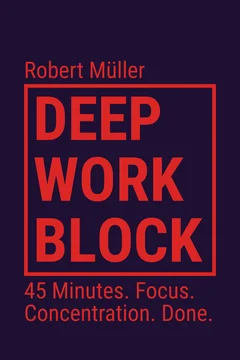
Maybe you know Deep Work and now keep hearing about Slow Productivity, or the other way round. One book says protect your focus, the other says take on less and slow down.
That can sound like two different directions. So the slow productivity vs deep work question becomes: which one should you follow?
Here you get the difference in plain words and an answer to whether the second book repeats the first. Then you see how to use both in one working day. It all comes down to the smallest unit, one block of focused work.
What is the difference between Deep Work and Slow Productivity?
Deep Work is about the quality of your attention while you work. Slow Productivity is about how much you take on, and at what pace.
Both titles name two things at once. Deep work is a book and a way of working, and so is slow productivity. I compare both here, the books and the ideas behind them.
| Deep Work | Slow Productivity | |
|---|---|---|
| Subtitle | Rules for Focused Success in a Distracted World | The Lost Art of Accomplishment Without Burnout |
| Published | 2016 | March 5, 2024 |
| Core idea | Distraction-free concentration on demanding work | Do Fewer Things, Work at a Natural Pace, Obsess Over Quality |
| Guards (my summary) | Your attention while you work | Your workload over time |
Here is Newport’s definition in Deep Work. “Professional activities performed in a state of distraction-free concentration that push your cognitive capabilities to their limit.” That is the concept, and the rest of this article uses the word in that sense.
The three principle names of Slow Productivity come from Newport’s own announcement of the book. How they play out in a working day comes further down.
Is Slow Productivity just Deep Work repeated?
No, Slow Productivity is not Deep Work repeated, even though both books share one line of thought against busyness. The table already shows that they answer different questions. Here is how close they are, and where they part.
- Same line: Newport notes that Deep Work and Alex Soojung-Kim Pang’s Rest were often paired as anti-busyness books.
- Early roots: He wrote about a “slow productivity” revolution on April 7, 2021, years before the book came out.
- Different question: Deep Work asks how to work with full focus.
- Different scale: Slow Productivity asks how much to commit to, and how fast.
My reading: same theme, different scale. Neither “repeat” nor “replacement” fits, and neither book is the upgrade of the other.
They are two scales of the same line against busyness, and you can use both at once.
Where Deep Work and Slow Productivity meet
The two meet at a feeling you probably know. You were busy all day and got nothing done. Slow Productivity is written against exactly this kind of busyness, the line both books share.
So I measure a day by what gets done, not by how busy it felt. Three focused 45-minute blocks are worth more than eight hours of half-concentrated work. What really fits into a block, I had to learn.
In practice, both books meet in one block with one goal, checked against what you got done.
The unit both ideas depend on: one block
One block with one goal sounds small. Yet both ideas take for granted that such a block succeeds, and that is exactly where I had to start.
The books on focus I read explained why focus matters. They also explained how to design a life and a daily routine around it.
None of them showed me how to actually sit down and work with concentration for 45 minutes. To me, they all aim too big.
So I started with the smallest unit: a single block of concentrated work. Master it, then repeat. The block has seven phases:
- Set up body and space (Before)
- Set your goal and begin (Start)
- Stay in focus (During)
- End the block clean (Stop)
- Recover the right way (Break)
- Stack your blocks (Repeat)
- Close out the day (After)
I repeat the block only as long as the quality of my blocks holds. Sometimes you take longer and longer to get into it.
You sit in front of the task, and nothing happens. Then the workday is over, even if it has only been three hours.
That is where my method meets a natural pace. What counts is performing well over weeks and months, not going all out on a single day.
How Deep Work and Slow Productivity fit into one working day
Once the single block works, you don’t have to choose between the two books. Each Slow Productivity principle has a clear counterpart in how one Deep Work Block runs.
The table is my own mapping of the three principles onto the rules I work by. It shows how I handle the same concern, not what Slow Productivity prescribes. The thought sheet in it is a sheet next to you where you note distracting thoughts, usually other tasks.
| Slow Productivity principle | In one Deep Work Block |
|---|---|
| Do Fewer Things | One block goal; other tasks go on the thought sheet |
| Work at a Natural Pace | Block length by today’s state; better one block too few |
| Obsess Over Quality | Judge by results, not by blocks counted |
Even inside one focused hour, fewer open things help. Leroy (2009, Organizational Behavior and Human Decision Processes) found that people struggle to shift attention away from an unfinished task. Their performance on the next task suffers.
For the third principle, quality, judge the day by its results, not by the number of blocks you managed. Two blocks with good results are better than five blocks you just dragged yourself through.
Let Deep Work guard the hour and Slow Productivity guard the week. Master the hour first: three focused 45-minute blocks are worth more than eight half-focused hours. See how it works →
FAQ
Should you read Deep Work or Slow Productivity first?
There is no required order, because each book stands on its own. My suggestion: start with the book that matches what breaks first for you. Trouble keeping focus during work points to Deep Work, too many commitments point to Slow Productivity.
Does slow productivity work if you can’t choose your workload?
Slow Productivity is only partly in your hands if you can’t choose your workload. Even then, the goal of your next block stays in your hands. So does a short block as the smallest unit.
My rule of thumb: “When in doubt, start shorter.”
How many hours of deep work a day fit with slow productivity?
For me, the realistic upper limit for highly concentrated deep work per day is four to six hours. That fits a natural pace.
On good days I manage five to six hours, across blocks of varying length. On weak days it’s three, and that’s perfectly fine.