Deep work sounds like hours of silent focus. With ADHD, your attention often fades long before that. So you wonder whether deep work and ADHD fit together at all.
This article shows what deep work asks of you. You learn how to size and protect one block on the day you’re having. You see whether working next to someone helps, and what to do when the block flows or the day ends.
Does deep work work for ADHD?
Yes, it can, if you work in smaller pieces. You work one block at a time and size it to your day. You don’t need hours of silence.
The author Cal Newport explains what deep work is in his book Deep Work (2016). It is professional work done with full focus and no distractions, and it pushes your thinking to its limit. The definition doesn’t name a number of minutes.
Short blocks count as deep work too. On a day when you feel less rested and clear, do 35, 25 or 15 minutes instead of 45. To see whether there is a lower limit, read about the minimum time for deep work.
Medication is a separate topic. To work without it, read about focusing with ADHD without medication.
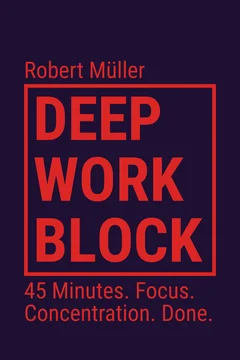
My book doesn’t mention ADHD. It starts with the smallest unit: one single block of focused work. What follows is how I would apply that block to ADHD.
How to do deep work with ADHD: check your state first
That block starts before the timer, with an honest check of how you feel today. Ask yourself two questions: “Am I awake?” and “Can I think clearly?”
Everything else depends on this check. If you are tired and force yourself to work anyway, you get little done. Your answer decides the block:
- Fit (rested and clear): 45 or 90 minutes at full effort.
- Not quite fit: a shorter block, or activate your body first.
- Massively tired: a power nap of 10 to 20 minutes, or postpone the block.
To pick the length, start with the longest block, 90 minutes. Then go down: 45, 35, 25, 15. Stop at the first length that feels doable.
If you’re unsure, pick the shorter one. See how long a deep work session should be.
If you feel strongly unmotivated, 15 minutes is enough to start.
To activate your body, do one to two minutes of hard exercise right before the block. If you don’t feel like it, start with a single exercise.
Keep your phone and chat out of the block
Once you know your block’s length, protect it. Before the timer starts, turn off your phone and close chat.
A single interruption can ruin a whole block. Most interruptions are predictable, so you can deal with them once, before you start.
- Turn your phone off and put it in a drawer in another room.
- Tell the people who often contact you when you can’t be reached.
- Close email, chat and social media, then every app and tab this task doesn’t need.
- Turn on Do Not Disturb on your computer.
If much of your work happens in chat, closing it is harder. To see how to handle that, read how to avoid distractions and do deep work.
Inside the block, two sheets of paper help. The protocol sheet holds your goal for the block.
On the thought sheet, you note unrelated thoughts in a few keywords. Then you go back to the task. Every step of such a block is in the full block for focusing with ADHD.
Keep the phone away during your breaks too. A quick check turns into 15 minutes of scrolling.
Does body doubling help with deep work?
With phone and chat gone, does it help to work while another person is there? That is called body doubling. Two recent studies on it found different results.
In Deep Work Block, people around you know you’re unavailable, so the block stays quiet. The book doesn’t cover body doubling.
| Study | Schuenke and Moore (2025) | Ara and colleagues (2025) |
|---|---|---|
| Who | People with ADHD, with or without medication, and people without ADHD | 12 adults with ADHD, with a human or AI body double |
| Task | Reading part of the ACT, a US college test | Laying bricks in virtual reality |
| Result | No measurable effect on performance, focus or calm | Finished faster; rated their own accuracy and focus higher than when alone |
| Kind of study | Conference poster; number of people not given | Early paper; review by other researchers not stated |
Schuenke and Moore name a limit themselves. Their setup may not match how people use body doubling to start and finish tasks.
My book suggests a test for coffee and music. Use the same test here.
Do one block with a body double and one without, on different days. Then compare what you got done, not how it felt.
Whatever you find, the rest of the block stays the same. Your phone stays off, and your goal stays on paper.
When the block flows, and when the day is done
With or without a body double, the timer rings at some point. If the work flows, keep going, and if it doesn’t, stop. When your blocks keep getting worse, the workday is over.
Flow is the state in which you’re most productive. Hyperfocus is a separate topic, so read about the difference between deep work and hyperfocus.
- It flows: ignore the timer or turn it off, and keep going.
- It doesn’t flow: stop now. Don’t add “just a bit longer.” Your brain needs the break, even if you don’t feel it.
- Blocks keep getting worse: starting takes longer, and the protocol sheet stops helping. Then the workday is over, even if you only worked three hours.
Before I stop, I always note the next step. After the break, I can continue right away. I don’t need time to figure out where I was.
One block too few is better than one too many. Overworking today costs you tomorrow. To plan a good day, read about how many hours of deep work per day make sense.
Tomorrow’s first block starts with the same honest check of how you feel. From there, a few fixed steps carry you through to the break, on good days and on weak ones. See how it works →
FAQ
How do you do deep work with AuDHD?
AuDHD means having both autism and ADHD. Deep work with AuDHD uses the same block.
Check how you feel, set a short timer and write your goal on paper. Earplugs or headphones without music and a clear desk are already part of every block.
What if you can’t start a deep work block with ADHD?
Make the first step of the deep work block smaller. On the sheet with your goal, write the next action. That is the smallest concrete step you can take now.
If nothing works, switching to another part of the same task is better than giving up.
Do people with ADHD take longer to refocus after an interruption?
The well-known 23-minute figure can’t answer that. Its study had no ADHD group. Researcher Gloria Mark watched people at work.
In 2006, she gave Gallup an average. Going back to an interrupted task on the same day took 23 minutes and 15 seconds.