You know what deep work is. Maybe you’ve tried a few deep work tips already, like phone away and notifications off. And still you couldn’t stay focused for long.
Here you get eight techniques in the order one block needs them. A block is a timed stretch of focused work on one task. You also learn what to do when you get stuck, and where to start.
What are deep work techniques?
Cal Newport’s book Deep Work describes deep work as distraction-free concentration that pushes your thinking to its limit. A deep work technique is a small action that protects that concentration at one moment of a block. That moment can be before the block, at its start, during it or when the timer rings.
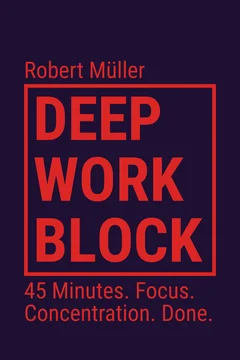
Here are eight from my book.
| Technique | When | What it does |
|---|---|---|
| 1. Phone off and out of sight | Before | Removes a device built to grab attention |
| 2. Close what distracts on screen | Before | Shuts email, Slack, social media and extra tabs |
| 3. Earplugs or headphones, no music | Before | Shields you from noise you can’t control |
| 4. A timer | Start | Gives the block an end, so starting is easier |
| 5. A written block goal | Start | Shows what will be done when the timer rings |
| 6. A thought sheet | During | Holds thoughts that are off the task, so your head goes quiet |
| 7. The next mini step | During | Brings you back when you lose your place or get stuck |
| 8. A clean stop and a real break | Stop, Break | Helps you pick up fast and lets your head recover |
Before every block, check honestly: are you awake and thinking clearly? In my book, this check is not one of the steps.
If you’re massively tired, take a power nap of 10 to 20 minutes or postpone the block. Forcing yourself to work that tired doesn’t help. More on how to focus when you’re tired.
Before the block: remove what can interrupt you
Before you set the timer, remove what could break the block: your phone, your screen and the noise. In a 2005 study, Gloria Mark, Victor Gonzalez and Justin Harris watched 24 information workers at their jobs. More than half of their larger pieces of work, like preparing a proposal, were interrupted (57 percent).
Turn your phone off and put it in a drawer or cabinet in another room. It must be out of your line of sight. Decide consciously when you use it: only in longer breaks or after work.
Then close email, Slack and social media, the biggest attention thieves. Close every other app and browser tab you don’t need for this task, and turn on Do Not Disturb. You’ll find more on how to avoid distractions during deep work.
Last, put in earplugs or noise-cancelling headphones as a shield against noise. The headphones are not there for entertainment, so don’t play music. That’s my clear answer to whether you can do deep work with music.
At the start: give the block an end and a goal
Two techniques start the block: a timer gives it an end, and a written goal gives it a target. My book adds a third start step, the music decision. You already made that one above: no music.
Set a timer before you start, so the work has an end and starting gets easier, even with unpleasant tasks. Pick 15 to 90 minutes, based on how awake and fresh you feel, and start shorter if you’re not sure. The details are in how long a deep work session should be.
Then write your block goal on your protocol sheet. That’s a blank sheet for your goal and work steps. Write the goal as a finished state, like “First draft of the outline is done”, not as an activity.
Make the goal ambitious but doable. A goal that is too big makes you feel overwhelmed and frozen. A goal that is too small gives you no push.
During the block: use paper when your thoughts wander or you get stuck
Your thoughts will wander, and sometimes you’ll get stuck. That’s normal. You handle both on paper.
My book has three tools for this phase. Two are on paper, for when the work doesn’t flow.
When a thought pulls you from the task:
- Catch it: notice that you’re following a thought that has nothing to do with the task. This step takes practice.
- Write it down: a few keywords on your thought sheet, a second sheet just for these thoughts.
- Return: look at your protocol sheet and keep going.
Sometimes I lose the thread and no longer know where I am in the task. Then I write down the next mini step. Just thinking about it brings me back into the task, and the written step becomes my anchor.
Getting stuck is not a reason to end the block. Describe the problem in one sentence on your sheet, then write the smallest next step. If nothing works, switch to another aspect of the same task.
When the timer rings: stop clean, then take a real break
When the timer rings and you’re in flow, keep going. Flow means you’re deep in the task and the work runs easily. Getting something done counts more than filling the time on the timer.
If you’re not in flow, stop now. Don’t add “just a bit longer.”
Note in one sentence where you are and what the next step would be. Then check your block goal without judging.
After that, take a real break. It should empty your head and get your body moving.
- Move: a few jumping jacks, squats or stretches, or some quick tidying up.
- Get fresh air: step outside, or air out the room.
- Skip your phone: a quick check turns into 15 minutes of scrolling.
- Skip email and messages: they pull your mind into other matters.
The right length depends on your block, so check how long deep work breaks should be.
Which deep work technique should you start with?
Start with one block. In my book, the smallest unit is a single block of concentrated work: master it, then repeat. Inside that block, the techniques come in the order it needs them.
Not every technique is needed every time, so take what works for you and skip the rest.
I count two of them among my most important tools. The timer is my key tool for productivity. The protocol sheet is my key tool for focus.
Your first blocks won’t be perfect: you’ll forget steps and get distracted anyway, and that’s normal. It gets better with every block, and after a few weeks the process is routine. For the full process, see how to do deep work, step by step.
So pick one task and do one block with it. Half an hour of reading is enough to know every step, from the phone in the drawer to the break. See how it works →
FAQ
What are Cal Newport’s deep work strategies?
In his 2016 book Deep Work, Cal Newport organizes his advice into four rules. His depth philosophies, ways to fit deep work into your life, belong to the first rule. The deep work techniques in this article come from Deep Work Block and are made for a single block.
Do deep work blocks have to start on the hour or be the same length?
Deep work blocks don’t have to start at a full hour, like 9:00 or 10:00. They also don’t all need the same length.
Tell the people who contact you often that you’re unreachable at certain times. For days full of meetings, see deep work with too many meetings.
Do you need an app for deep work techniques?
Deep work techniques need only paper, a pen and a timer. For the timer, the built-in clock app on your computer works.
Use your phone as a timer only if you have nothing else. Then put it in airplane mode with Do Not Disturb.