You want to know how much deep work you really do. Your days feel full, but you can’t say what the focused hours brought.
Here you see how to track deep work with one sheet and a timer. You learn what to write, when, and what to do with the sheet at the end of the day. You also see where counting hours fits in.
What is the simplest deep work tracker?
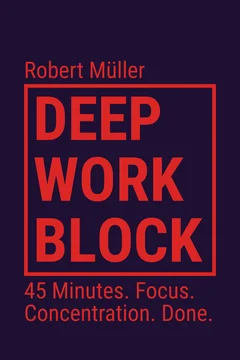
The simplest deep work tracker is a blank sheet of paper and a pen on your desk. My book calls it the protocol sheet. It holds the goal of each block, a timed stretch of focused work on one task.
To record the time, you don’t need a special tracker app. The timer app on your computer does the job. Mac and Windows have one built in.
Your block results still go on paper. One sheet is enough, with no notebook and no app. Writing by hand makes you think more slowly and clearly than typing.
A goal you only keep in your head stays vague. A goal on paper is fixed. You see it in front of you the whole time.
What should you write in a deep work log?
On that sheet, three short entries per block are enough. Each has its own moment: one at the start, two when the timer rings.
| Entry | When | What it gives you |
|---|---|---|
| Block goal: the result you want from this block | Right after you set the timer | A clear target for this block |
| Next step | When you stop the block | You can continue right away after the break |
| Goal check: reached, partially, not at all | Right after the next step | An honest look at the block, without judging |
Write the goal as a finished result, like “Outline is done” instead of “write outline”. That gives your brain a clear picture of the result.
For each new block, write the goal on the same sheet, under the last entry. By evening, you have a record of the whole day’s results. To see the whole block from start to stop, read how to do a deep work session.
How do you track deep work hours?
If you want hours as well, note how long each block ran and add up the total. Cal Newport’s hour tally works like that. Each week, he recorded the total hours he spent in unbroken concentration.
On his blog, he wrote that a small total is embarrassing and pushes you to find more time to focus. Later, he found the tally not enough for his work stretches of four to seven hours.
Instead, he planned his deep work on his calendar four weeks ahead. Planning ahead is a different method. To see how it works, read how to schedule deep work.
I don’t measure how many blocks I do. The effort is too much for me. I would rather focus on my content than on my self-management.
What counts is what each block produced. You don’t need to count the blocks.
If you still want a number, read about whether to track hours or milestones. For a weekly figure, see how many hours of deep work per week make sense.
Do short blocks belong on your sheet?
Yes, every block goes on the sheet, whatever its length. You log a goal and a result, and a short block has both. So it gets the same three entries as a long one.
In an hour log, short stretches may not count at all. The writer Scott H. Young ignores stretches under 30 minutes and adds up the longer ones each evening (blog post, 2021).
My book sets five lengths: 90, 45, 35, 25 or 15 minutes. You pick one based on how you feel that day. Even when you feel very unmotivated, a 15-minute block is better than none.
That 15-minute block still gets its three entries. For the lower limit of a block, read about the minimum time for deep work.
How much deep work tracking is too much?
Beyond those three entries, tracking is too much once it takes your attention off the work. Flow, the state where the work almost runs by itself, breaks easily. Once you’re out, it takes minutes to get back in.
During a block, three situations decide what you write.
- The work flows: write nothing. No logging, no notes, no optimizing until later.
- An unrelated thought shows up: write a few keywords on your thought sheet, a second sheet for such thoughts.
- You don’t know what to do next: write the next mini step on your protocol sheet. Then do that step.
On weak days, when you need a lot of structure, write down every step. Otherwise, write only when you’re stuck, because writing costs time and attention.
If you’re not sure what flow is, read how deep work and flow differ.
What do you do with the sheet at the end of the day?
After your last block, look once at everything you wrote that day. Take the protocol sheet and ask yourself what you got done today.
Every goal you reached and every step you finished is in front of you. You wrote it yourself, one block at a time. Seeing it brings satisfaction.
This look back is one part of closing your workday. The rest belongs to the shutdown ritual.
Over time, this look back teaches you how much you can really get done in a day. Your next block goals become more exact. Your plans get better too.
A good log starts with a good block goal. Learn to set one you can reach in the next 45 minutes, and your sheet fills with results. See how it works →
FAQ
Does tracking your progress help you reach your goals?
A review of 138 studies found that checking progress helps you reach your goals (Harkin and colleagues, Psychological Bulletin, 2016). The effect was larger when people physically recorded their progress. The studies looked at goals in general rather than deep work.
Should you keep your old protocol sheets?
A protocol sheet is the page with your block goals. After the day’s review, you decide: archive it or throw it away. If you keep one, put it in a tray, because a clean desk makes tomorrow’s first block easier to start.
How long does it take to log a deep work block?
Logging a block of focused work takes about 30 seconds when you stop. Those seconds save you minutes when you start again after the break.
Writing the goal at the start takes a few lines more. After a few blocks, you won’t want to skip it.