Your 25-minute timer rings just as the work gets going. Or you wonder if your short rounds count. Pomodoro technique vs deep work: which one is right?
You’ll see what sets them apart, what a timer does well and when 25 minutes is enough. You’ll learn what to do when the bell rings while the work flows. And you’ll see what Cal Newport said and which one to use.
What is the difference between Pomodoro and deep work?
To me, Pomodoro is a rhythm for your time, while deep work is a kind of work. One decides when you pause. The other decides what you work on and how deeply you focus.
With Pomodoro, you work 25 minutes, then rest about 5 minutes, with a longer break after four rounds.
Cal Newport, author of Deep Work (2016), explains what deep work is: professional work with full focus and no distractions. Such work pushes your mental abilities to their limit. I put the two side by side like this:
| Pomodoro | Deep work | |
|---|---|---|
| What it is | A rhythm for your time | A kind of work |
| What it decides | When you work and when you pause | What you work on and how deeply you focus |
| Length | 25 minutes per round, then a short break | Not part of the definition |
| What it needs | A timer | One demanding task, free of distractions |
In my view, a 25-minute round is deep work if the task is demanding and nothing distracts you. The timer doesn’t decide that.
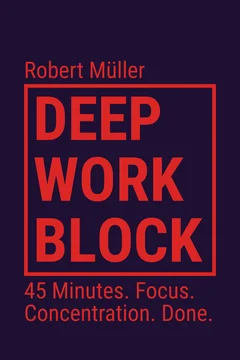
A Deep Work Block, a single block of concentrated work, uses a timer too. It lasts 15 to 90 minutes, depending on how you feel that day. So how do you set it?
What Pomodoro gets right
A timer makes starting easier because the work gets a clear limit. Setting it is a starting gun that tells your brain work time begins now. It also tells your brain the work stops at a set time, which helps most with unpleasant tasks.
In a Deep Work Block, the timer comes with a block goal: the result you want from this block. You write it on your protocol sheet, a sheet of paper for your goal and work steps.
Phrase the goal as a finished state, like “First draft of the outline is done.” If starting is still hard, read about why deep work feels impossible to start.
Is 25 minutes long enough for deep work?
Sometimes. My book sets 25 minutes for an unfocused day. When you feel fresh, a longer block uses more of what your brain can do.
The length depends on your state today, so check how you feel and pick one:
- 25 minutes: for a day when you’re unfocused. It uses your short attention span and gives you a quick break.
- 45 minutes: for a day when you feel fresh, focused and motivated. It’s ideal because it uses your brain fully without heavy tiredness.
- Shorter or longer: 15 minutes when you’re very unmotivated, because it gets you started. 90 minutes when your energy and motivation peak.
My own blocks run from 25 to 45 minutes, depending on my mental fitness. If you’re unsure, start shorter.
The break grows with the block: a long block needs a longer break than a short one. To go deeper, read how long a deep work session should be and how long deep work breaks should be.
What if the timer rings while you’re in flow?
Keep going, and stop only when you’re not in flow. Flow is the state where you’re most productive, and in a block it matters more than the timer. A fixed 25-minute rhythm would send you into the break.
Flow is fragile: once you’re out, it takes minutes to get back in. The goal isn’t to fill the minutes on the timer. The goal is to get something done.
When I’m deep in a task and making progress, I switch the timer off until my brain needs a break. Don’t watch the timer: if you keep checking the time left, you’re not in flow. For more, read how flow relates to deep work.
If the timer rings and you’re not in flow, that’s when to stop a deep work session. Don’t add “just a bit longer,” because your brain needs the break even if you don’t feel it. Write the next step on your protocol sheet so you can continue right after the break.
What did Cal Newport say about Pomodoro?
Cal Newport also mentions Pomodoro, in a post about breaks. In “On Deep Breaks” (2016), he gives students advice from an earlier book he wrote for them. They should study in 50-minute sessions with 10-minute breaks.
People who follow the Pomodoro technique give similar advice, he writes. He also writes that few people can stay at full focus much longer than an hour:
“[F]ew can maintain peak cognitive intensity for more than an hour or so without some sort of relief.”
Cal Newport, “On Deep Breaks” (2016)
In the same post, he writes that breaks should usually last no more than 10 to 15 minutes. Meals are the exception. My book sets a 15-minute break after a 45-minute block, which fits that range.
In another 2016 post, Newport describes his own sessions: 4 to 7 hours in a row, several times a week. That is his own practice for his research. It isn’t advice for everyone.
In my view, long sessions and short rounds can both be deep work, because the work decides.
Pomodoro or deep work: which one is better?
You don’t have to choose: deep work is the work, and a timer only sets its pace. A timer belongs in every block. But the preparation before you start is what turns timed minutes into deep work.
So don’t ask which method is better. Ask what you do in the minutes on the timer.
Without a timer, you either work too short or too long. Set a timer for housework or other tasks you don’t enjoy, and you’ll be surprised how fast they’re done. To combine both, read how to use the Pomodoro technique for deep work.
Before each block, prepare like this:
- Switch your phone off and put it out of sight.
- Close every program this task doesn’t need.
- Set the timer and write your goal.
Your space stays set up, so the second block of the day starts faster.
Start with one prepared block today. After a few rounds, preparing takes only a few minutes, and you make full use of the minutes that follow. See how it works →
FAQ
Is Pomodoro or deep work better for studying?
A 2025 study by Smits, Wenzel and de Bruin compared break methods, including Pomodoro, while students studied. It didn’t test deep work.
With Pomodoro breaks, students got tired faster than with breaks they chose themselves. Overall, though, the groups did not differ in tiredness or motivation.
Is Flowtime better than Pomodoro for deep work?
Flowtime is a method with flexible breaks instead of fixed rounds. In a 2025 survey by Renacido, Mayordo and Biray, 55.6% of 108 students preferred Pomodoro and the rest preferred Flowtime. The authors link Pomodoro with structured settings and Flowtime with deep work and creativity.
What should you do in a Pomodoro break?
In a Pomodoro break, move your body lightly and do things that need little focus. Step outside, stretch or tidy up for a few minutes. Skip your phone, social media and messages, because their new input follows you into the next round.