You block “focus time” in your calendar and read about “deep focus” and “deep work” elsewhere. It sounds like one thing in three outfits.
Focus work vs deep work is a real difference. Below I sort the words, show where the line runs, and how to turn a focus block into deep work.
What does “focus” actually mean?
“Focus” is used for four different things, and most of the confusion comes from mixing them up:
| Term | What it describes | The question it answers |
|---|---|---|
| Focus | Your attention, held on one chosen task | Where is my attention? |
| Focus time | A calendar slot kept free of interruptions | When am I protected? |
| Focus work | Any work you do with full attention | How am I working? |
| Deep work | Focusing without distraction on a cognitively demanding task | How am I working, and on what? |
Focus is the state, and focus time is the slot. Deep work needs the state and a demanding task.
A focus-time block can just as well be filled with email. Only the last row also asks what you work on.
Where does focus work end and deep work begin?
That last row is where the line runs. Focus work becomes deep work when two conditions meet.
The task demands your full thinking, and nothing can pull you away. Both come straight from the definition:
“the act of focusing without distraction on a cognitively demanding task”
Cal Newport, page for his book Deep Work on his website
That’s the whole difference. To check a task, ask two questions: would the result get worse during a side conversation? And is everything that could interrupt you switched off or out of sight?
Yes to both means deep work. Yes only to the second means focus work on an easier task. Routine work you can do while distracted, like most email, is usually called shallow work.
Is deep work the same as flow?
No, and neither of those two questions asks about flow. Flow is a state that can happen during deep work, but deep work doesn’t depend on it.
Cal Newport separates deep work from flow in a Huberman Lab episode. It is called “Dr. Cal Newport: How to Enhance Focus and Improve Productivity.”
He separates deliberate practice from flow and says deep work often takes you beyond your comfort zone. Flow, he says, is closer to a performance state than a practice state.
I still aim for flow, and everything I do to prepare a block is there to get me into it. But flow is fragile, so it can’t be the measure.
Why feeling focused isn’t the same as being focused
Flow is not the only feeling that can fool you. Three things feel like focus and aren’t. Music is one.
Here are all three look-alikes, with what each one gives you instead of focus:
- Energy: coffee gives you drive, and some people don’t notice they’re losing concentration. “Energy without direction is restlessness, not concentration.”
- Pleasantness: music makes work more pleasant, and that is easy to mistake for being productive.
- Absorption: an interesting link or a research tangent feels like work, but it doesn’t belong to the current task.
Absorption is the hardest to spot. You can surf the web or chase a seemingly productive idea, fully absorbed.
Time flies, and you still don’t touch your task. So absorption alone is not the test.
What helps is noticing your own mind as it wanders off, a skill called metacognition. At first you’ll notice how often you drift off. That’s normal, not a sign of weakness, and it gets better with every block.
The test is simple: one block with music, one without. “Don’t compare the feeling, compare the result.” Coffee gets the same test on two days, judged by the actual work output, not by how awake you felt.
How do you turn focus time into deep work?
If the feeling isn’t the measure, the setup and the result are. A focus-time slot only protects the time.
To turn it into deep work, you need a demanding task and no distraction inside it. Calendar tools block the slot for you, but they don’t decide what happens inside.
The first half is the task choice: a demanding task, in a block when you have energy. An easy task wastes that energy, just as a hard task goes nowhere without it.
The steps below handle the second half, no distraction. They start with the smallest unit, a single block of concentrated work: master it, then repeat.
- Turn off your smartphone and hide it in another room.
- Close every program you don’t need and turn on Do Not Disturb.
- Set the timer for the block.
- Your protocol sheet is the paper for goals and work steps. Write the block goal on it as a finished result: “Outline is done.”
- Park distracting thoughts on the thought sheet, a second page just for them, in a few keywords. Then return.
- Write down the next mini step when you don’t know how to go on.
The first block takes the longest. The second is faster, because the environment is already set up: desk cleared, smartphone hidden, headphones ready. Only the goal is new, and you write it below the previous one on the same protocol sheet.
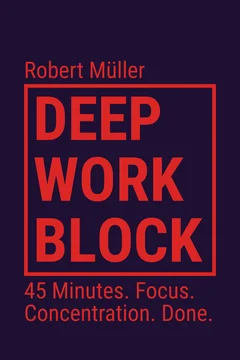
The calendar gives you the slot. After a few blocks, the setup takes only a few minutes. In return, you get 45 minutes of deep work on one demanding task. See how it works →
FAQ
Is deep focus the same as deep work?
Not in the way I use the two terms. Deep focus describes your state; deep work also asks what you work on.
My suggestion: use deep focus for how concentrated you are. Use deep work for focusing without distraction on a demanding task.
Is the Pomodoro technique deep work?
The Pomodoro technique is a timer method. Whether a session is deep work depends on the task and the distractions.
For me, Pomodoro helped sometimes. But I still had to start with willpower, and that was exactly what was missing.
How long should a deep work block be?
A deep work block’s length depends on your state. It ranges from 15 minutes when you’re strongly unmotivated to 90 at maximum fitness.
When you’re fit, focused and motivated, 45 is ideal. When in doubt, start shorter, because you can always go over.
How many hours of deep work can you do in a day?
I put the realistic upper limit for hours of deep work per day at four to six. Some manage less, some more. Wanting to work eight hours with full concentration is unrealistic.